11 · Mind of God
Infinite Creation
Emerges: God
“We’re not worthy!”
If any dimension earns the name “Mind of God,” honesty demands saying plainly what science actually found when it climbed this high: not God — limits. In the span of a single century, mathematics and physics proved a series of precise theorems about what any mind, any machine, any observer bound inside a universe can ever know. They are not vague gestures at mystery. They are among the hardest, most carefully checked results in the history of thought — and every one of them is a statement about a boundary that cannot be crossed from the inside.
Kurt Gödel, 1931. Any formal system that is consistent and rich enough to express ordinary arithmetic must contain statements that are true but unprovable within the system — and no such system can prove its own consistency. State with equal care what the theorem does not say. It does not say truth is unknowable: every one of Gödel’s unprovable statements can be proved in a larger system, which then has unprovable statements of its own. It does not prove that human minds outrun machines, and it does not prove that God exists — Gödel, who privately drafted an ontological argument of his own, never offered incompleteness as evidence for it. What it proves is a shape: every formal mind has an outside.
Alan Turing, 1936. Five years later the limit moved from logic to machinery. Turing defined computation itself — the numbers “calculable by finite means” — and then proved the halting problem undecidable: no algorithm can determine, for every possible program, whether that program eventually finishes or runs forever. Some questions are not merely hard; they are closed to computation as such. Gregory Chaitin later condensed the point into a single object, Ω — the halting probability — a perfectly well-defined real number whose digits are provably beyond the reach of any finite theory. The theorem is real and rigorous; the cosmic readings sometimes hung on it are speculation, and should be labelled as such.
Jacob Bekenstein, 1981. Physics then added a wall of its own. A finite region of space containing finite energy can hold only a finite amount of information, and the later holographic bound ties that maximum not to the region’s volume but to its surface area. On this accounting the observable universe is a vast but strictly finite book — and no reader bound inside it can ever hold every page at once. Even if the cosmos is a thought, no thinker within the cosmos can think all of it.
And the metaphor itself has an honest history. In December 1926 Einstein wrote to Max Born that quantum mechanics was imposing but that the “Old One” does not play at dice — his lifelong shorthand not for a personal deity but for a lawful cosmos; asked directly in 1929, he cabled back that he believed in “Spinoza’s God,” who reveals himself in the lawful harmony of what exists. The still more famous line — “I want to know His thoughts; the rest are details” — appears nowhere in Einstein’s hand: it is a recollection published by Esther Salaman in 1955, decades after the conversation it reports, and should be flagged as unverifiable. Stephen Hawking then gave the metaphor its most quoted modern form in the last sentence of A Brief History of Time — and spent much of his later life explaining that by “the mind of God” he meant the body of natural law, not a person behind it.
So this page claims no discovery of God. It reports the mathematics of horizons: proof that every consistent system holds truths it cannot reach, that computation faces questions it can never answer, that space itself caps what any region can record. Every mind the theorems describe is a mind with an edge — and whatever holds all of it, if anything does, is by these very theorems something no system on the inside can fully prove. That silence is the science.
“The ‘computable’ numbers may be described briefly as the real numbers whose expressions as a decimal are calculable by finite means.”
— Alan Turing, mathematician · On Computable Numbers, 1936
“Quantum mechanics is certainly imposing. But an inner voice tells me that it is not yet the real thing. … I, at any rate, am convinced that He is not playing at dice.”
— Albert Einstein, physicist · Letter to Max Born, 1926 (trans. Irene Born)
“If we find the answer to that, it would be the ultimate triumph of human reason—for then we would know the mind of God.”
— Stephen Hawking, physicist · A Brief History of Time, 1988
These are the theorems of the horizon — the rung where mathematics turns around and proves things about its own edges. Each one is a precise statement of something no observer inside a system can ever complete.
Consistent + rich enough for arithmetic ⇒ true but unprovable statements exist
Kurt Gödel’s incompleteness theorems, 1931
Every formal mind has an outside — and cannot certify its own sanity.
No algorithm decides, for every program, whether it halts
Alan Turing, 1936
Some questions are not hard — they are closed to computation itself.
S ≤ 2πkRE / ℏc
The Bekenstein bound, 1981
A finite region of space holds finite information: the universe is a vast but finite book.
Ω — the halting probability
Gregory Chaitin
A perfectly defined number no theory can ever compute; unknowability with a name.
Philosophy’s oldest answer to the question of what holds the holding is also its simplest: a Mind. In 1078 Anselm of Canterbury defined God as the outer limit of conceivability itself — that than which nothing greater can be conceived — and argued that such a being, to be greatest, must exist and not merely be imagined. The argument drew famous objections almost at once and forever after: the monk Gaunilo answered that by the same logic a perfect island must exist, and Kant, seven centuries later, that existence is not a predicate — not a property a concept can simply include. Yet even the objectors kept the definition. Whatever God means, Anselm had named the ceiling of thought.
Spinoza collapsed the gap between the Mind and the world. In the Ethics of 1677, everything that exists, exists in God: one infinite substance, of which every thing is a mode and every thought a thought within an infinite intellect. His contemporaries called it atheism and banned the book; it is more honestly called pantheism — not a personal God outside creation, but creation itself as the body of God’s thinking. On Spinoza’s page the eleventh dimension is not above the map; it is the map.
George Berkeley completed the inversion in 1710. Reality does not contain minds, he argued; a Mind contains reality. To be is to be perceived — and things persist when every human eye is shut because God never stops perceiving them. The mountains do not blink out at midnight; they are held. Creation, on this view, is not an event at the beginning of time but one unbroken act of attention — which is very nearly this dimension’s definition of itself.
“From the necessity of the divine nature must follow an infinite number of things in infinite ways—that is, all things which can fall within the sphere of infinite intellect.”
— Baruch Spinoza · Ethics I, Prop. XVI, 1677 (trans. R. H. M. Elwes, 1883)
“All the choir of heaven and furniture of the earth, in a word all those bodies which compose the mighty frame of the world, have not any subsistence without a mind… they must either have no existence at all, or else subsist in the mind of some Eternal Spirit.”
— George Berkeley · A Treatise Concerning the Principles of Human Knowledge §6, 1710
“And indeed, we believe that thou art a being than which nothing greater can be conceived.”
— Anselm of Canterbury · Proslogium ch. II, 1078 (trans. Sidney Norton Deane, 1903)
Across the scriptures the cosmos rests inside a knowing. The Hebrew prophets set the divine Mind above ours as the heavens stand above the earth — thought of a wholly other order, which our categories reach toward but never enclose. The Upanishads turn the telescope around: prajnanam brahma — consciousness itself is Brahman — and every world is led by knowledge, rests on knowledge, is knowledge. Not a Mind above the world, but Mind as what the world is made of.
The Tao Te Ching refuses even the image of a knower. Looked for, it is not seen; listened for, it is not heard; it can only be called the Form of the Formless, the Semblance of the Invisible. Three grammars, then — transcendence, identity, ineffability — carrying one shared intuition: that Creation is held in something that comprehends it, whether that something is above us, is us, or is beyond every name.
“For my thoughts are not your thoughts, neither are your ways my ways, saith the LORD. For as the heavens are higher than the earth, so are my ways higher than your ways, and my thoughts than your thoughts.”
— Christianity & Judaism · Isaiah 55:8–9 (KJV)
“It rests on knowledge (the Self). The world is led (produced) by knowledge (the Self). Knowledge is its cause. Knowledge is Brahman.”
— Hinduism · Aitareya Upanishad III.3 (trans. F. Max Müller, 1879)
“We look at it, and we do not see it… We listen to it, and we do not hear it… This is called the Form of the Formless, and the Semblance of the Invisible.”
— Taoism · Tao Te Ching ch. 14 (trans. James Legge, 1891)
From this dimension emerges God. The eleventh dimension is the Mind of God: infinite Creation itself. The imagination behind the Hands, the conception behind every created thing. Where the sixth dimension is memory within existence, the eleventh is the imagining of existence.
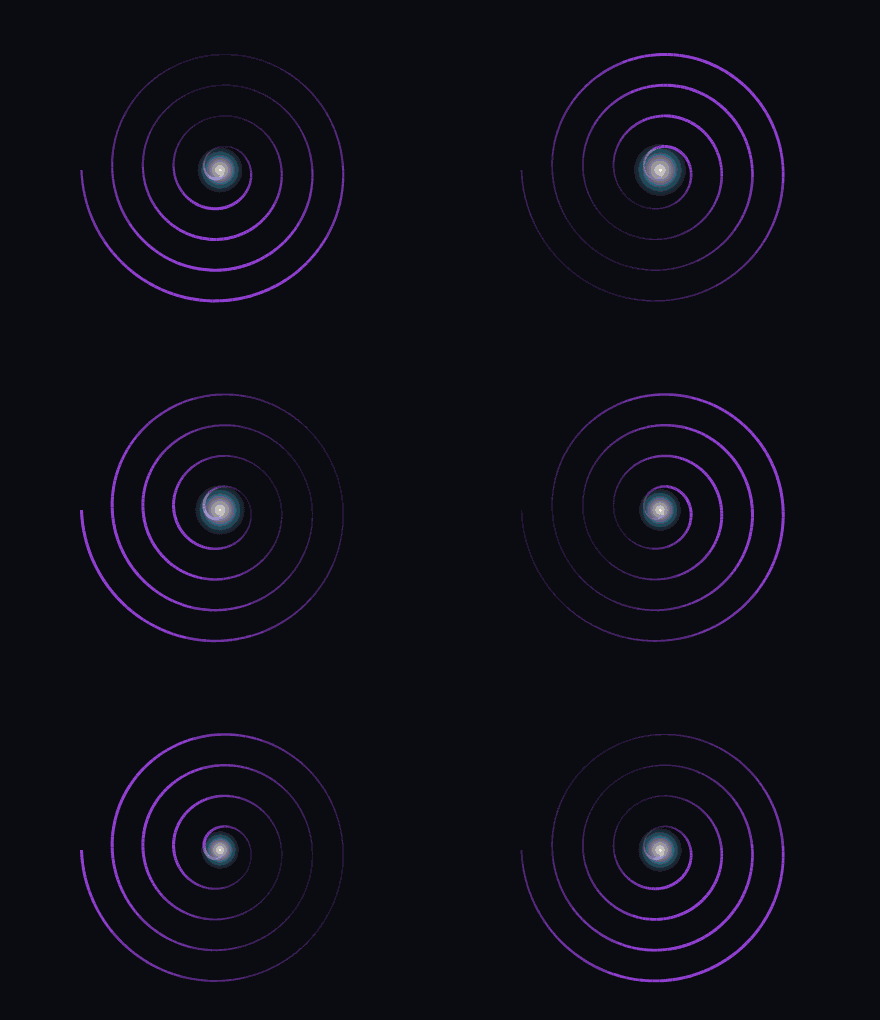
Everything below it — every point, every line, every sphere, every universe, every multiverse, the Omniverse itself — is a thought held in this Mind. All possibilities, imagined at once, forever. It is drawn as a spiral, and that is fitting: a curve that circles its own center endlessly, self-similar at every scale — the fractal signature of the whole map, thinking.
And what does an infinite Mind use to create? One thing remains at the top of the map — the thread that has been running through every rung since the first vibration. The twelfth dimension: Time.
Each dimension is all possible versions of the dimension below it, held in a continuum.

