7 · Universe
All possible configurations of 1D–6D — one complete whole
Emerges: Gravity
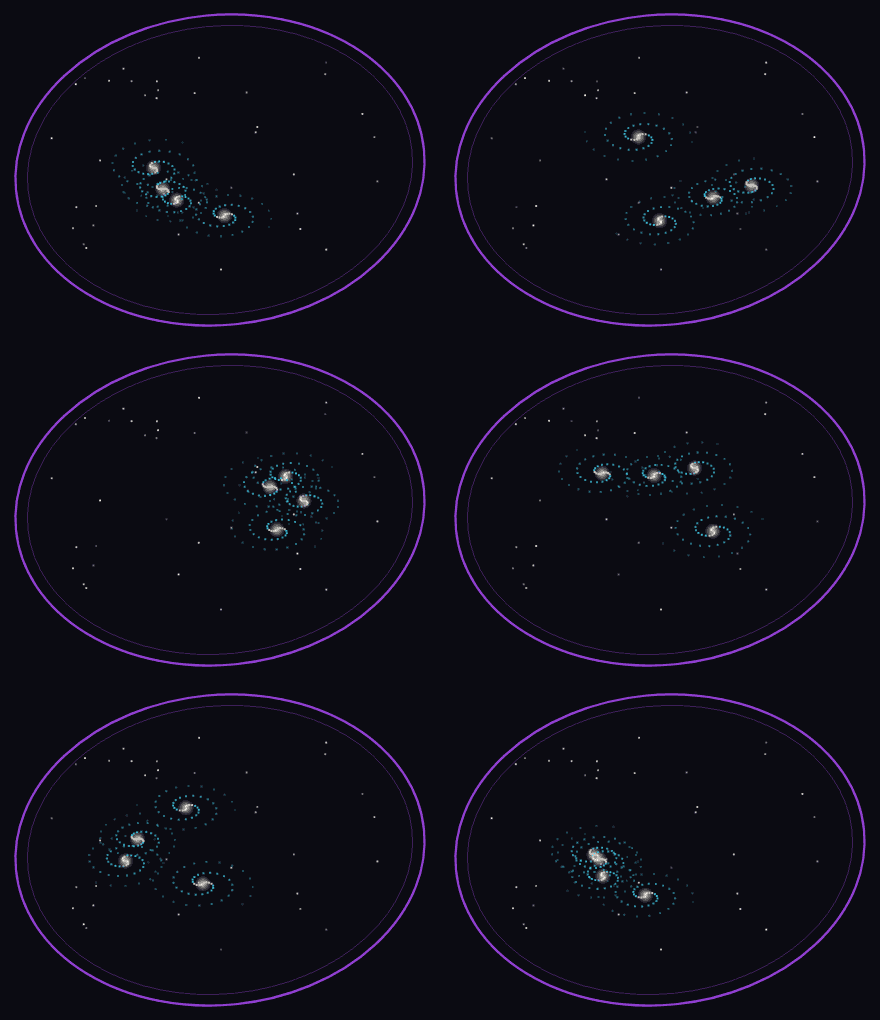
“Where is everybody?”
General relativity is the only physics that takes the universe itself as its subject. Everything else describes things in the universe; Einstein’s equations describe the whole thing at once, which is why cosmology only became a science after 1915. And their content is startling once you strip the tensors away. On the left is geometry. On the right is matter and energy. Read the equation one way and it says matter tells spacetime how to curve; read it the other way and it says curved spacetime tells matter how to move. Gravity is not something reaching across a gap. It is the shape of space and time, and things falling are simply things going straight through a shape that is bent.
The theory has kept coming true in ways it had no obligation to. On 29 May 1919 expeditions to Brazil and the island of Príncipe photographed stars beside an eclipsed Sun and found their light bent by about 1.75 arcseconds — Einstein’s number, and exactly twice what Newton predicted. On 14 September 2015 two detectors in Louisiana and Washington registered a ripple in spacetime from two black holes merging 1.3 billion light years away, a century after Einstein predicted such waves and then spent years doubting they were real. In April 2019 a planet-sized array of radio telescopes produced an image of the shadow of the black hole at the centre of galaxy M87, and in May 2022 of the one at the centre of our own. Worth saying precisely: those are not photographs of black holes. They are pictures of the dark region where the horizon blocks light, ringed by glowing gas.
The black hole story has a detail that is hard to believe and entirely true. Karl Schwarzschild found the first exact solution to Einstein’s new equations while serving with the German army on the Russian front, computing artillery trajectories. He sent it to Einstein, who wrote back that he had not expected anyone could solve the problem so simply. Schwarzschild contracted a rare autoimmune disease at the front and was dead within four months, aged 42. His solution contains the radius — 2GM/c² — inside which every possible future path leads inward. The event horizon is not a wall and not a surface. Nothing marks it. Someone falling through a large one would notice nothing whatsoever. It is the surface of no return not because anything stops you, but because past it, “out” has stopped being a direction you can travel.
And then the numbers, which are worth stating carefully because most of them are quoted wrongly. There are somewhere between 100 and 400 billion stars in the Milky Way — the range is honest, because faint red dwarfs vastly outnumber Sun-like stars and nobody can count them. Estimates of galaxies in the observable universe run from a few hundred billion up to two trillion; the higher figure extrapolates to galaxies too faint to see, and measurements of the sky’s total glow taken by the New Horizons spacecraft from beyond Pluto favour the lower end. More than 6,000 planets around other stars have now been confirmed, the first of them in 1995. Everything made of atoms — every star, every planet, every person, every telescope that has ever looked at any of it — is about 5% of what the universe contains. Roughly 27% is dark matter and 68% is dark energy, and we do not know what either of them is.
One last number, because it is the one people get wrong most often. The observable universe is about 93 billion light years across, even though it is only 13.8 billion years old. That is not because anything outran light. Nothing moves through space faster than light, ever. But space itself has been expanding the whole time that ancient light was in flight, carrying its source along with it — so the matter that emitted the oldest light we can see is now about 46 billion light years away. The radius is not how far the light travelled. It is how far away the thing that sent it has since been carried.
“According to the general theory of relativity, the geometrical properties of space are not independent, but they are determined by matter.”
— Albert Einstein, Nobel laureate 1921 · Relativity: The Special and General Theory, §XXXII, 1920 (trans. Robert W. Lawson)
“Spacetime tells matter how to move; matter tells spacetime how to curve.”
— John Archibald Wheeler, Princeton physicist · Geons, Black Holes, and Quantum Foam, 1998 — general relativity in twelve words
“The only elements in the construction of black holes are our basic concepts of space and time. They are, thus, almost by definition, the most perfect macroscopic objects there are in the universe.”
— Subrahmanyan Chandrasekhar, Nobel laureate 1983 · Nobel Lecture, On Stars, Their Evolution and Their Stability, 1983
“One may say ‘the eternal mystery of the world is its comprehensibility.’”
— Albert Einstein · Physics and Reality, Journal of the Franklin Institute, 1936 (trans. Jean Piccard) — the quotation marks are his own
This is the rung where gravity arrives, and where the universe stops being a setting and becomes an object with equations of its own.
Gμν + Λgμν = (8πG/c⁴) Tμν
The Einstein field equations · 1915
Geometry on the left, matter and energy on the right. Gravity is not a force acting across space — it is the curvature of spacetime, and falling is what going straight looks like inside a bent shape. Einstein added the Λ term in 1917 to hold the universe still, called it his mistake, and it is now back as dark energy.
rs = 2GM/c²
The Schwarzschild radius · 1916
The radius inside which every future path leads inward. Found by Karl Schwarzschild on the Russian front within weeks of Einstein publishing the equations, and four months before his death.
S ∝ A, not V
Bekenstein–Hawking entropy · 1972–74
A black hole’s entropy is proportional to the area of its horizon rather than the volume it encloses. Everything a region can contain is written on its boundary — which is where the holographic principle came from, and it is one of the strangest true facts in physics.
“Where is everybody?”
The Fermi paradox · 1950
Enrico Fermi asked it over lunch at Los Alamos, and it has not been answered since. Billions of stars, billions of years, more than six thousand confirmed planets — and silence. It is the only open question on this page that could be settled tomorrow by a single signal.
Emerson noticed something about the stars that has stayed true: we would find them unbearable if they were rare. If they appeared one night in a thousand years, he said, people would believe and adore, and pass the memory down for generations. They appear every night, so we walk under them and think about the parking. Familiarity is the only defence we have against how strange this is, and it works far too well.
The Stoics built an entire practice out of refusing that defence. Marcus Aurelius kept instructing himself to think of the universal substance and how small a portion of it he had, of universal time and the indivisible sliver of it assigned to him — not to feel worthless, but because he found that a man who genuinely holds the scale in his head becomes very hard to insult and very hard to frighten. Seneca took the same thought and turned it outward: all that you behold is one, and we are the parts of one great body. Nature made us related, he wrote, because she made us from the same source and to the same end.
And then, nineteen centuries later, a spacecraft on its way out of the solar system turned around and took a photograph. Carl Sagan had argued for that picture for years against people who pointed out, correctly, that it had no scientific value. What came back was a single pale pixel, and what Sagan wrote about it is probably the most useful paragraph anyone has written about our situation. The argument is not that we are small. It is that there is nowhere else to go and nobody coming, and that this ought to change how we treat each other. It is an ethical conclusion drawn from an astronomical fact, and the reasoning holds.
“Look again at that dot. That’s here. That’s home. That’s us… In our obscurity, in all this vastness, there is no hint that help will come from elsewhere to save us from ourselves… To me, it underscores our responsibility to deal more kindly with one another, and to preserve and cherish the pale blue dot, the only home we’ve ever known.”
— Carl Sagan, astronomer and planetary scientist, 1934–1996 · Pale Blue Dot, ch. 1, 1994 — on a photograph taken by Voyager 1 from beyond Neptune
“If the stars should appear one night in a thousand years, how would men believe and adore; and preserve for many generations the remembrance of the city of God which had been shown!”
— Ralph Waldo Emerson, American essayist, 1803–1882 · Nature, Chapter I, 1836
“All that you behold, that which comprises both god and man, is one — we are the parts of one great body. Nature produced us related to one another, since she created us from the same source and to the same end.”
— Seneca, Roman Stoic philosopher, c. 4 BCE–65 CE · Moral Letters to Lucilius 95.52 (trans. Richard Mott Gummere)
Genesis finishes the making of the world in a single line — the heavens and the earth were finished, and all the host of them — and that word host is doing quiet work. It is a military word. The stars are not decoration in that sentence; they are an assembled multitude, counted and mustered. The Psalms then do something that no other ancient literature quite manages: they look up at that host and immediately turn the telescope around. What is man, that thou art mindful of him? The question is three thousand years old and it is exactly the question a photograph of a pale blue dot asks.
Elsewhere the traditions reach for scale rather than smallness. The Bhagavad Gita has Arjuna granted the sight of the universal form and seeing the whole universe at once, undivided and divided into countless parts, with a brightness the text can only compare to a thousand suns rising together. And Guru Nanak, in the Japji, simply refuses to count: there are continents, worlds and universes, and whoever tries to describe them will never arrive at an end. Written five hundred years before anyone had the faintest instrument for checking, and it turns out to be the most accurate estimate on this page.
“Thus the heavens and the earth were finished, and all the host of them.”
— Judaism & Christianity · Hebrew Bible / Old Testament, Genesis 2:1 (King James Version)
“When I consider thy heavens, the work of thy fingers, the moon and the stars, which thou hast ordained; What is man, that thou art mindful of him?”
— Judaism & Christianity · Hebrew Bible / Old Testament, Psalm 8:3–4 (King James Version)
“If in the heavens, the lustre of a thousand suns burst forth all at once, that would be like the lustre of that mighty one… There the son of Pânḥdu then observed in the body of the god of gods the whole universe (all) in one, and divided into numerous (divisions).”
— Hinduism · Bhagavad Gita 11.12–13 (trans. Kāshināth Trimbak Telang, 1882)
“There are continents, worlds, and universes. Whoever trieth to describe them shall never arrive at an end.”
— Sikhism · Guru Nanak, Japji, Pauri XXXVII, Guru Granth Sahib (trans. Max Arthur Macauliffe, 1909)
The seventh dimension is our Universe: everything below it — line, plane, sphere, space, electromagnetism, memory — gathered into one complete whole. All possible configurations of 1D through 6D, held together as a single expression of existence.
And it emerges from consciousness observing it. The sixth dimension ended with memory analysing itself, and this is what that analysis produces. Perhaps a universe is not a container that happens to have observers standing around inside it. Perhaps a universe is what observation makes.
Now look at what matter is doing to the space it occupies. Every particle sits in a volume that was empty and displaces it. Where there is more matter, there is more displacement — and between a region crowded with matter and a region that is still mostly empty, there is a differential. A difference in pressure, if you like, between the full and the void. Perhaps that power differential is what we have been calling gravity all along: not a pull reaching out from an object, but the universe answering the fact that something is where nothing used to be.
Everything that exists, exists in the universe — including the mind reading this sentence right now. But ours is only one configuration, and the rule of this map allows no final edition. All possible universes must exist too. That is the eighth dimension: the Multiverse.
Each dimension is all possible versions of the dimension below it, held in a continuum.

