8 · Multiverse
All possible universes — zero-point vibrational variations
Emerges: Imagination
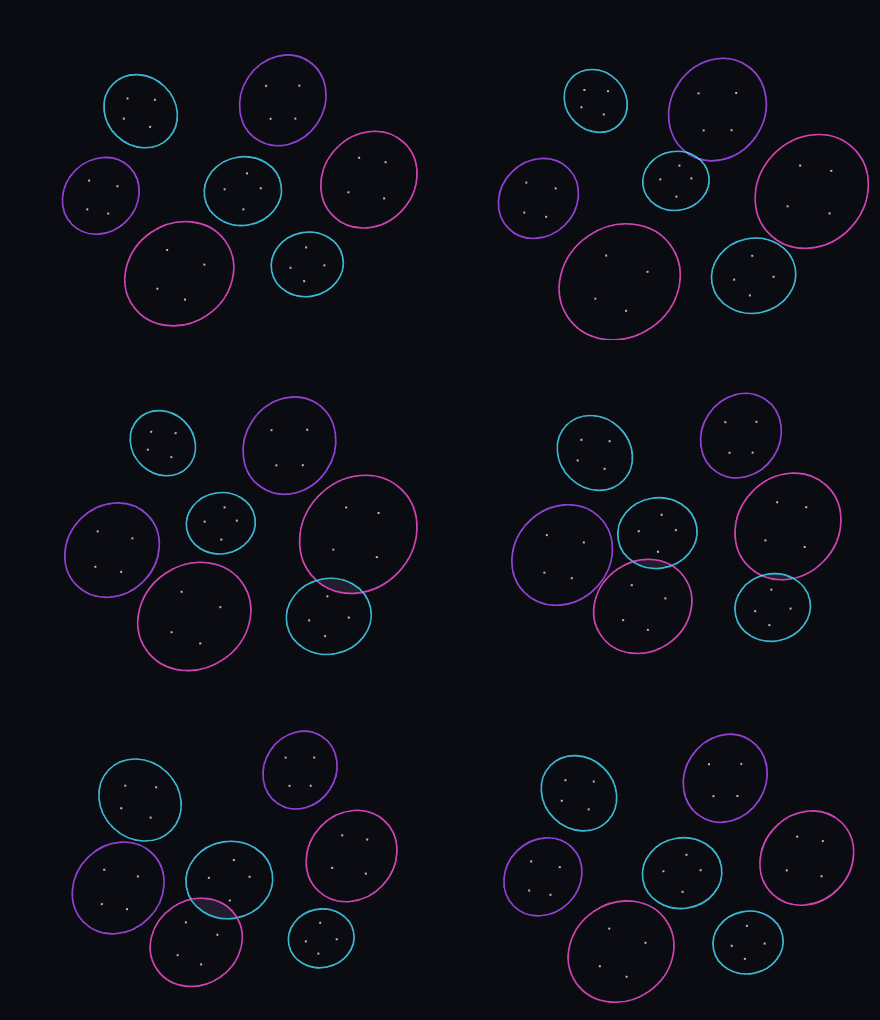
“Sliders was an awesome show!”
The word “multiverse” describes not one idea but several, and they come from different corners of physics — so start with the one nobody argues about. Light has had 13.8 billion years to reach us, which means we see a finite sphere: the observable universe. Nothing whatsoever in the data suggests that space stops at that edge; the simplest reading is ordinary space carrying on with the same laws, merely out of view. And because the expansion is accelerating, “not yet seen” hardens into “never to be seen” — sufficiently distant regions are unobservable in principle, forever. Max Tegmark calls this Level I, and calls it rather uncontroversial. In 2001 Jaume Garriga and Alexander Vilenkin pushed the arithmetic to its strange conclusion: a horizon-sized volume can hold only finitely many arrangements of matter, so if space is truly infinite, every possible arrangement — every possible history, including duplicates of this one — occurs somewhere, infinitely often. That conclusion hangs entirely on the “if”: an infinite universe is consistent with every measurement we have, and proven by none of them.
The second multiverse arrived in 1957 in a Princeton doctoral thesis. Quantum mechanics as taught had two rules: the Schrödinger equation, under which the wavefunction evolves smoothly and predictably, and the collapse postulate, under which a measurement snaps it to a single outcome. Hugh Everett III proposed the most economical heresy available — a deletion. Keep the equation; discard the collapse. What remains is one universal wavefunction in which a measurement does not pick a result but correlates the observer with all of them, so that the observer, in his word, “branches” — and each branch holds a copy certain that its outcome was the only one. His adviser John Wheeler published a supportive note beside the paper, while also cutting it heavily to appease Niels Bohr, whose Copenhagen circle was unmoved. The name it wears now — many-worlds — is not Everett’s: Bryce DeWitt attached it around 1970, after a decade in which the paper had been almost entirely ignored. Everett himself had left for Pentagon defence analysis before the thesis was even finished, never returned to physics, and died in 1982, just as the revival was beginning.
The third multiverse comes from cosmology’s most successful idea. In 1981 Alan Guth proposed that the infant universe underwent a burst of exponential expansion — inflation — which solved real puzzles and made a testable prediction: primordial density ripples of nearly, but not exactly, the same strength at every scale. The satellites delivered; the Planck mission measured the tilt right in the band the theory requires. That part is genuine evidence. But Alexander Vilenkin showed in 1983, and Andrei Linde in 1986, that inflation generically refuses to stop: inflating space multiplies faster than it decays, so once begun it keeps budding off “pocket universes” forever — the term is Guth’s — and our Big Bang becomes a local event, one bud on an endlessly growing tree. The honest ledger comes straight from Guth’s own review of the subject: the other pockets are unobservable, and deciding what an infinity of them makes probable — the measure problem — remains unsolved.
String theory added a menu. In 2000 Raphael Bousso and Joseph Polchinski showed that the theory’s hundreds of quantized fluxes multiply into a staggering number of possible vacuum states, each one a different set of “constants of nature”; Leonard Susskind named the terrain the landscape. The famous count of 10⁵⁰⁰ appears in neither founding paper — it is a rough later estimate, and some later counts run vastly higher — so “of order” is the only honest phrasing. Populate that landscape with eternal inflation’s pockets and you get the anthropic argument: we find our constants friendly to life because pockets with hostile constants contain nobody to do the finding. The argument’s one striking success actually came first: in 1987 Steven Weinberg used anthropic reasoning to predict that the cosmological constant should be tiny but probably not zero — a decade before the supernova measurements found dark energy, precisely such a value.
And then the dispute, which deserves to be stated as carefully as both sides state it. No multiverse variant has yet made a confirmed prediction that rival ideas did not also make. In Nature in 2014, George Ellis and Joe Silk — cosmologists with impeccable observational credentials — argued that awarding scientific status to untestable worlds undermines the thing that makes physics physics. Sean Carroll answers that we judge theories by inference from equations that already earn their keep empirically, and that the other universes are simply the straightforward reading of theories we already trust; Weinberg, Martin Rees, Guth, Vilenkin and Tegmark have each, in their own registers, agreed. In 2015 physicists convened a conference in Munich titled “Why Trust a Theory?” to argue about exactly this. Both camps read the same data. What they dispute is what science is allowed to conclude from it — which makes this the first rung of the map where the argument itself is part of the science.
“From the viewpoint of the theory all elements of a superposition (all ‘branches’) are ‘actual,’ none any more ‘real’ than the rest.”
— Hugh Everett III, Princeton · ‘Relative State’ Formulation of Quantum Mechanics, Reviews of Modern Physics, 1957 — from the note added in proof, answering the objection that we never feel ourselves split
“In an eternally inflating universe, anything that can happen will happen; in fact, it will happen an infinite number of times.”
— Alan H. Guth, father of inflationary cosmology · Eternal Inflation and Its Implications, 2007 — written not as a boast but to open his section on why prediction becomes the hard part
“In our view, the issue boils down to clarifying one question: what potential observational or experimental evidence is there that would persuade you that the theory is wrong and lead you to abandoning it? If there is none, it is not a scientific theory.”
— George Ellis & Joe Silk, cosmologists · Defend the Integrity of Physics, Nature, 2014
“Multiverse theories are utterly conventionally scientific, even if evaluating them can be difficult in practice.”
— Sean Carroll, physicist · Beyond Falsifiability: Normal Science in a Multiverse, 2018 — the other camp’s answer, stated just as plainly
This is the rung where the equations begin speaking in plurals. Every entry below is real, published physics — and every one is honest about the same thing: the other worlds it implies have not been observed.
iℏ ∂Ψ/∂t = ĤΨ — with no collapse, ever
The universal wavefunction · Hugh Everett III, 1957
Everett’s entire proposal is a deletion: keep the Schrödinger equation, discard the rule that measurement collapses the wavefunction. What remains is one wavefunction for the whole universe, and every branch of it contains an observer certain that theirs was the only outcome.
Inflating volume ∝ e3Ht
Eternal inflation · Alexander Vilenkin, 1983; Andrei Linde, 1986
Inflating space multiplies faster than it decays into ordinary hot-big-bang universes, so inflation, once begun, never ends everywhere. Our Big Bang becomes a local event — one bud on a tree that keeps growing.
Nvacua ~ 10500
The string landscape · Bousso & Polchinski, 2000; named by Susskind, 2003
String theory admits a staggering number of self-consistent vacua, each with its own constants of nature. The famous count is a rough estimate — it appears in neither founding paper — but the menu is real, and if eternal inflation samples it, our life-friendly numbers become a selection effect rather than a miracle.
Level I → II → III → IV
The four levels · Max Tegmark, Parallel Universes, 2003
Every multiverse proposal, sorted by increasing strangeness: space beyond our horizon, other pocket universes, quantum branches, and finally all mathematical structures. His Level I arithmetic says that in infinite uniform space a copy of you is expected about 101029 metres away — conditional, always, on the infinity.
The word “multiverse” is younger than the light bulb, and it was born as a complaint. In May 1895 William James stood in front of a Harvard student society to answer the question they had actually asked him: is life worth living? Nature, he told them, tells no single moral story — kindness and cruelty pour from the same spring, and no god’s character could be read straight off her face. Visible nature, he said, is a moral multiverse, not a moral universe. The first appearance of the word in print is an accusation of incoherence. It took a century for physicists and philosophers to pick it up, dust it off, and turn it into a map of all possible worlds — a fate James, who loved the universe precisely for its looseness and unfinished edges, might well have enjoyed.
Philosophy had housed the idea long before it had the word. Leibniz pictured God as the ultimate imaginer: in the divine understanding sit infinitely many possible universes, each complete down to the last detail, each aspiring to exist — and exactly one gets chosen. The others remain what they have always been in his system: ideas. Three centuries later the philosopher David Lewis removed the safety catch. His modal realism holds that every possible world is exactly as real as this one — “absolutely every way that a world could possibly be is a way that some world is” — and that the worlds stand at no distance from here: not far away, but nowhere relative to us, differing without touching. Almost nobody followed Lewis all the way, and nobody has quite refuted him either; he cheerfully admitted that the strongest argument against him was what philosophers still call the incredulous stare.
And the thought is ancient. Around 300 BCE Epicurus wrote to his student Herodotus that since atoms are infinite in number and space has no edge, nothing exists to stop other worlds from forming — worlds like ours and unlike ours, without limit. The letter survives only because Diogenes Laertius copied it into a biography six centuries later; Giordano Bruno revived the idea in 1584 and was burned in Rome in 1600, in part for refusing to let it go. Which leaves a question that this page’s framework answers with a single word. If the other worlds are really there, what faculty do we possess that ever touches them? Perhaps the philosophers’ answer and this map’s answer are the same one: imagination — the mind’s native ability to stand in one actual world and walk through the others.
“Visible nature is all plasticity and indifference,—a moral multiverse, as one might call it, and not a moral universe.”
— William James, American philosopher and psychologist · Is Life Worth Living?, 1895 — the first appearance of the word “multiverse” in print
“Now, as in the Ideas of God there is an infinite number of possible universes, and as only one of them can be actual, there must be a sufficient reason for the choice of God, which leads Him to decide upon one rather than another.”
— G. W. Leibniz, philosopher and mathematician · Monadology §53, 1714 (trans. Robert Latta, 1898)
“Furthermore, there are infinite worlds both like and unlike this world of ours.”
— Epicurus, Greek philosopher, c. 341–270 BCE · Letter to Herodotus, preserved in Diogenes Laertius, Book X (trans. Cyril Bailey, 1926)
The scriptures of the West keep their gaze on one creation — but the seams show. “In my Father’s house are many mansions,” Jesus tells his disciples on the last night before his death. Honesty first: the Greek word is monai — dwelling-places, rooms — and he is speaking of the afterlife, a place prepared for the faithful, not of cosmology; “mansions” is simply 1611 English for abodes. Yet the image the verse leaves behind is of a reality with more rooms than the one we can see. The rabbis went further. Noticing that Genesis says “and it was evening” before the first day had ever ended — as if time were somehow already running — Rabbi Abahu taught in the midrash that the Holy One created worlds and destroyed them before this one, until at last He said: this one pleases Me. Those are sequential drafts rather than parallel worlds, but the claim startles either way: ours is not the first.
No tradition multiplies worlds as cheerfully as India. The Bhagavata Purana says the universes — each a brahmanda, a world-egg — pour like dust motes through the pores of Maha-Vishnu’s resting body, and the devotional Brahma-samhita adds that all of them together last one of his exhalations: universes come and go with the divine breath. The Yoga Vasistha sends a sage beyond the shell of our world-egg and has him report back what he saw — world after world, floating like bubbles on an ocean that is not water but mind. Buddhist cosmology, meanwhile, counts in world-systems of a billion worlds each and then multiplies those without limit; the Lotus Sutra opens with a single ray of light from the Buddha’s brow illuminating eighteen hundred thousand complete worlds to the east, each with its own heavens and hells. The numbers are rhetoric of scale, meant to shatter the listener’s provincialism about our one world — which is, perhaps, exactly what the multiverse idea is for.
“In my Father’s house are many mansions: if it were not so, I would have told you. I go to prepare a place for you.”
— Christianity · New Testament, John 14:2 (King James Version)
“Rabbi Abahu said: This teaches that He continuously created worlds and destroyed them, until He created the current one, and said: ‘This one pleases Me, those did not please Me.’”
— Judaism · Midrash, Genesis Rabbah 3:7 (trans. The Sefaria Midrash Rabbah, 2022, via Sefaria.org, CC-BY)
“Such is the pure vacuous space of the Divine understanding, that like an ocean of light, contains these innumerable worlds, which like the countless waves of the sea, are revolving for ever in it.”
— Hinduism · Yoga Vāsiṣṭha III.30 (trans. Vihari-Lala Mitra, 1891)
“And at that moment there issued a ray from within the circle of hair between the eyebrows of the Lord. It extended over eighteen hundred thousand Buddha-fields in the eastern quarter, so that all those Buddha-fields appeared wholly illuminated by its radiance.”
— Buddhism · Lotus Sūtra (Saddharma-Puṇḍarīka), ch. 1 (trans. H. Kern, 1884)
From this dimension emerges Imagination. The eighth dimension is the Multiverse: all possible configurations of the universe, held in a continuum. Every variation, every alternate unfolding, every way the whole could be — all of them, all at once.
Where do the variations come from? Go back to the very beginning of the map: the zero point, vibrating. Every possible variation of that first vibration rings out a different universe. Same point, same vibration — different harmonics, different worlds.
With time removed, these are not parallel timelines. They are coexisting wholes — side by side, bumping and overlapping, the way all possible lines lie within a plane. And every one you can picture really is there. That is exactly what imagination is: the mind reaching across universes, visiting configurations other than this one.
An infinite amount of multiverses must live somewhere — and something must set the rules they all follow. That is the ninth dimension: the Omniverse.
Each dimension is all possible versions of the dimension below it, held in a continuum.

