9 · Omniverse
God’s kitchen — the rules governing all multiverses
Emerges: Heaven
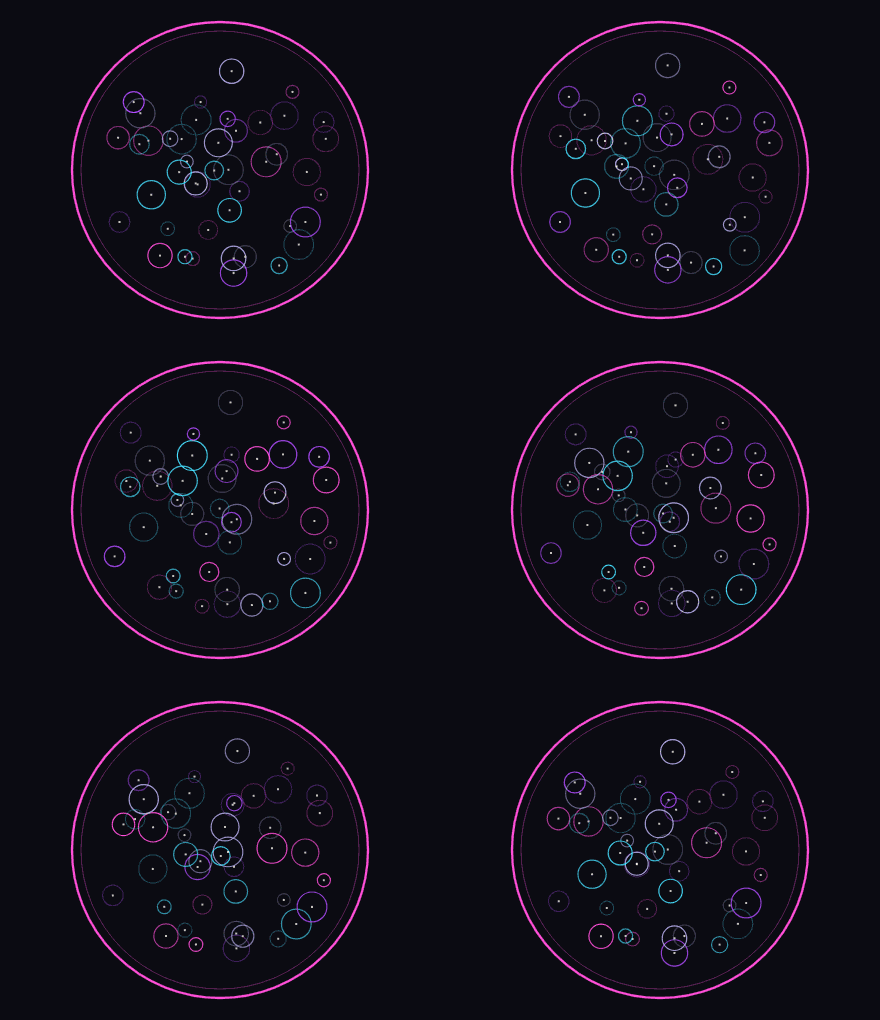
“What’s cookin’ good lookin’?”
Every equation in physics has two parts: the law, and the numbers you plug into it. Physics is magnificent at the first part and oddly silent on the second. The Standard Model plus gravity runs on roughly twenty-six dimensionless constants — pure numbers, the same in any system of units anyone could invent — and every single one of them is measured in a laboratory and typed in by hand. No accepted theory derives even one. The laws are the recipes; the constants are the amounts; and nobody knows who wrote the amounts in.
In 1999 the astronomer Martin Rees boiled the mystery down to six numbers. N, the strength of electricity over gravity, about 1036. ε, the efficiency of hydrogen fusion, 0.007. Ω, the density of the universe. λ, the cosmological constant. Q, the roughness of the early cosmos, about one part in 100,000. And D, the number of spatial dimensions: three. Nudge several of these even slightly and the story ends before it starts — no stars, no chemistry, no time for anything like life to get going. That sensitivity is a real observation about how the recipes behave. What it means is genuinely disputed: it is evidence of something needing explanation, not evidence of any particular explanation.
John Archibald Wheeler — the physicist who named the black hole — spent his last decades asking the question straight: where do the laws themselves come from? His slogan was “law without law,” and his conjecture, “it from bit,” pictured the laws not as eternal furniture but as something that congealed along with the universe, crystallizing out of information and acts of observation. He was careful to call it what it was — a research program and a provocation, not a result — and he said so himself, to the end.
Max Tegmark stands at the speculative far end: his Mathematical Universe Hypothesis — Level IV, in his own map of multiverses — says that every consistent mathematical structure simply is a universe. On that view the laws need no origin story, because all of them are real somewhere; ours just happens to be one of the structures that contains beings capable of asking about it. It is a serious argument, seriously made — and its critics ask a fair question in return: what observation could ever test it?
Lee Smolin’s cosmological natural selection takes the opposite tack: no designer, no plenum of all possibilities — just Darwin scaled up. Universes spawn new universes through black holes, he proposed in 1992, and the constants mutate a little with each bounce, so after enough generations most universes are tuned to make lots of black holes — which happens to require stars, carbon, and chemistry. Its great virtue is that it predicts: neutron stars, Smolin argued, should not exceed about two solar masses. Recent pulsar measurements near 2.3 solar masses strain that bound — which is exactly what a real idea risks, and what the untestable ones never do.
So the anthropic dispute stands where honest disputes stand: in the open. One camp says the constants look chosen because they are selected — in a vast ensemble of universes, only the life-friendly pockets contain anyone to take the measurements. The other camp answers that this is giving up too early, and that a deeper theory should one day derive the numbers outright. Both camps are first-rate; both read the same data; what they disagree about is what counts as an answer. Whatever writes the recipes in God’s kitchen, nobody has read the cookbook — and the people trying are doing some of the most honest work in science.
“So far as we can see today, the laws of physics cannot have existed from everlasting to everlasting. They must have come into being at the big bang.”
— John Archibald Wheeler, theoretical physicist · Information, Physics, Quantum, 1989
“One could perhaps describe the situation by saying that God is a mathematician of a very high order, and He used very advanced mathematics in constructing the universe.”
— Paul Dirac, Nobel laureate in Physics · The Evolution of the Physicist’s Picture of Nature, 1963
“…with a sufficiently broad definition of mathematics, it implies the Mathematical Universe Hypothesis (MUH) that our physical world is an abstract mathematical structure.”
— Max Tegmark, cosmologist · The Mathematical Universe, 2007 (arXiv:0704.0646)
This is the recipe card of the ninth dimension — the numbers every universe runs on, and the conjectures for where the rules themselves come from.
N ≈ 1036 · ε = 0.007 · Ω · λ · Q ≈ 10−5 · D = 3
Martin Rees’s six numbers, 1999
Nudge several of them slightly and there are no stars, no chemistry, and no time for life.
~26 dimensionless constants
The free parameters of the Standard Model + gravity
Measured and typed in by hand — no accepted theory derives a single one.
It from bit
John Archibald Wheeler’s conjecture, 1989
Physics crystallizing out of information and observation — law without law; a program, not a result.
Universes that make black holes make more universes
Lee Smolin’s cosmological natural selection, 1992
Darwin scaled up — and it sticks its neck out: neutron stars shouldn’t pass ~2 solar masses.
Every consistent mathematical structure exists
Max Tegmark’s Mathematical Universe Hypothesis, 2007
The speculative far end: the laws need no origin because all of them are real somewhere.
Behind every world that happens to exist, philosophy keeps finding a realm of pure pattern that simply is. Plato called it the place beyond heaven, where the true forms abide — colourless, formless, visible only to mind. Leibniz located the eternal truths inside the divine understanding itself, where every possible world sits complete as a blueprint awaiting choice. And Spinoza named the generating face of the totality natura naturans — nature naturing — the eternal activity by which reality pours out of its own necessity. His God, note, designs nothing: this is immanent necessity, not a craftsman at a drafting table.
Three maps of one country: the kitchen where being is written before it is served.
“But of the heaven which is above the heavens, what earthly poet ever did or ever will sing worthily? … There abides the very being with which true knowledge is concerned; the colourless, formless, intangible essence, visible only to mind, the pilot of the soul.”
— Plato · Phaedrus 247c, c. 370 BC (trans. Benjamin Jowett, 1892)
“It is farther true that in God there is not only the source of existences but also that of essences, in so far as they are real, that is to say, the source of what is real in the possible. For the understanding of God is the region of eternal truths or of the ideas on which they depend.”
— G. W. Leibniz · The Monadology §43, 1714 (trans. Robert Latta, 1898)
“By nature viewed as active we should understand that which is in itself, and is conceived through itself, or those attributes of substance, which express eternal and infinite essence, in other words… God, in so far as he is considered as a free cause.”
— Baruch Spinoza · Ethics I, Prop. XXIX, Note, 1677 (trans. R. H. M. Elwes, 1883)
The traditions that speak most seriously of Heaven agree, with surprising unanimity, that it is not the top floor of the cosmos. It is what exceeds the cosmos altogether — the container of containers. When Solomon finishes the temple, the grandest house ever raised to God in Israel, his dedication prayer opens with the admission that the whole project is impossible: the heaven of heavens itself cannot contain the One it was built for. Whatever Heaven names, it is not a bigger room. It is the fact that every room — and the house of rooms — is held.
The Upanishads say the same from the inside: the Self is the lord and protector of all things, and — the image is startlingly practical — a bank and a boundary, the embankment that keeps the worlds from washing into one another. Rules, in other words: the dike that keeps each reality itself. And the Tao Te Ching bows lowest of all, calling the Way deep and unfathomable, the Honoured Ancestor of all things — and then, in one of scripture’s most audacious lines, guessing that it might appear to have been before God.
“But will God indeed dwell on the earth? behold, the heaven and heaven of heavens cannot contain thee; how much less this house that I have builded?”
— Christianity & Judaism · 1 Kings 8:27 (KJV)
“He is the lord of all, the king of all things, the protector of all things. He is a bank and a boundary, so that these worlds may not be confounded.”
— Hinduism · Brihadaranyaka Upanishad IV.4.22 (trans. F. Max Müller, 1884)
“How deep and unfathomable it is, as if it were the Honoured Ancestor of all things! … I do not know whose son it is. It might appear to have been before God.”
— Taoism · Tao Te Ching ch. 4 (trans. James Legge, 1891)
From this dimension emerges Heaven. The ninth dimension is the Omniverse — the namesake of this entire site. It is all possible multiverses, held in a continuum, along with the rules that govern them: which harmonics are allowed, which worlds can be, how the recipe of any reality gets written.
Call it God’s kitchen. This is where the ingredients are kept and the recipes are set — every constant, every law, every ratio that decides what any universe below is permitted to become. Nothing cooks anywhere that wasn’t written here first.
This is Indra’s Net drawn at the grandest scale: each multiverse a jewel at a crossing of the net’s threads, every jewel reflecting all the others, the whole encoded in every part. A place where every possible world is held, complete and shining — there is an old word for that place. Heaven.
But a kitchen implies a cook. What shapes, holds, and molds even the container of all realities? The tenth dimension: the Hands of God.
Each dimension is all possible versions of the dimension below it, held in a continuum.

